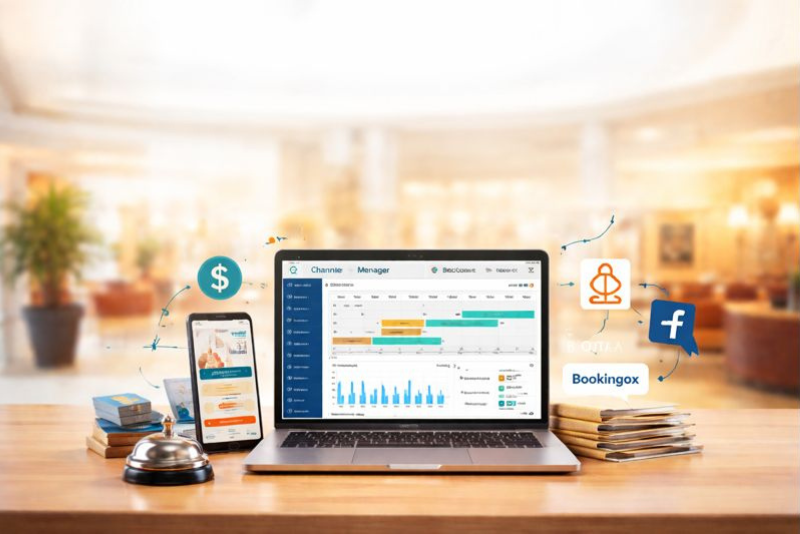
How a Channel Manager Can Increase Direct Bookings & Reduce OTA Fees
Channel managers are usually introduced as operational tools. They sync rates. They prevent overbookings. They save time.
All of that’s true. But if that’s the only way you’re using it, you’re leaving money on the table.
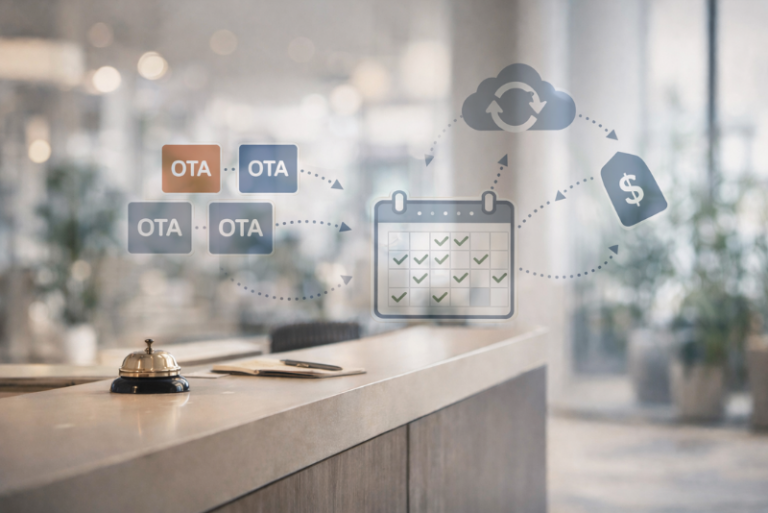
A channel manager increases visibility and occupancy by posting your hotel rates and availability in real time on external booking channels. It automatically synchronizes bookings and availability across multiple platforms.
Your channel manager can increase direct bookings. It is one of the few tools that touch every part of distribution: OTAs, your website, and how you control inventory and pricing across all of them. OTA fees don’t go down because you “try harder.” They go down when you deliberately manage your distribution.
This article presents practical channel manager strategies you can use to increase direct bookings and boost your hotel revenue.
What a Channel Manager Actually Does (and Why That Matters)

A channel manager distributes rates, availability, and restrictions across multiple booking channels. That includes OTAs like Booking.com and Airbnb, as well as your own website booking engine.
Your property management system (PMS) sets your rates and tracks bookings. The channel manager is what links your PMS to the various booking platforms. It’s the communication system between all the different channels.
A useful way to think about a channel manager is this: it’s the place where your distribution decisions are enforced. Channel managers enable property owners to manage all their reservations from a single centralized platform. They also enable sellers to list products across various marketplaces and their own direct booking website from a single interface, enabling multi-channel listing.
It won’t create a direct booking strategy for you. It communicates the strategy you choose. If every booking channel looks the same, it’s because your setup makes them the same.
The Distribution Problem Hotels Face with Online Travel Agencies

OTAs (online travel agencies) don’t just charge commission. They are a major part of the booking environment that hotels must manage and control.
Guests use OTAs because they can filter by price, location, and amenities, compare options quickly, and check out with a platform they trust, but OTA bookings often involve high commission fees and lower profit margins for hotels.
So the goal is to:
- Make direct bookings easy to win when guests do reach your site.
- Increase the number of guests who find your site before they commit to an OTA.
- Use direct bookings to reduce repeat commission over time.
A distribution strategy is essential to balance OTA presence and direct bookings, and channel managers support this by automating and optimizing your distribution channels.
Here Are 7 Strategies You Can Use To Boost Direct Bookings
Stop simply using your channel management software to distribute your availability and rates; use it to incentivise direct bookings and save yourself the commissions.
Strategy 1: Commission-Adjusted Pricing
OTAs charge commission. Direct bookings don’t have to.
If you treat the OTA rate as the “real” rate and match it everywhere, you’re baking commission into your direct pricing even though you don’t pay commission on direct bookings.
A more sensible approach:
- OTA rates absorb the cost of commission
- Direct rates reflect the absence of commission.
This doesn’t mean aggressive discounting. It means pricing based on actual economics.
How the channel manager is used
- Channel-specific rate plans, markups, or derived rates
- A consistent rule, not manual tinkering
- Centralized pricing in channel managers adjusts product prices across all platforms simultaneously, making it easier to implement promotional strategies.
If you want more direct bookings, the direct channel has to be meaningfully competitive. That usually starts with not charging people an OTA-inflated rate on your own direct booking site.
Strategy 2: Give Direct Bookings An Advantage
If the price is identical everywhere, then value has to carry the difference.
This is where hotels often get distracted. Guests don’t switch channels for small perks that don’t change the cost or quality of the stay.
What guests actually care about tends to be simple:
- Breakfast included
- A better room category, or a clearer path to one
- Room upgrades for direct bookers
- Better cancellation terms
- Packages that change the total cost of the stay (not token add-ons)
Direct bookings enable hotels to offer tailored recommendations, room upgrades, and amenities, enhancing the guest experience and fostering loyalty.
Establishing a direct relationship with guests through direct bookings also allows hotels to gather valuable guest data, such as preferences and booking patterns.
The point is not to “add extras.” The point is to make the direct offer structurally better, so guests understand it immediately.
How the channel manager is used
- Direct-only rate plans (for example: “Breakfast Included” as a real package)
- OTA listings kept as room-only, or with tighter terms
- Clear separation between direct and third-party offers
If a guest checks your website after seeing you on a third-party website, they shouldn’t need to hunt for the reason to book direct.
Strategy 3: Use Availability as Leverage
Many hotels give OTAs full inventory all the time. That removes one of the few levers you control.
Availability shapes booking behavior, especially on high-demand dates.
Practical examples:
- Reduce OTA availability on peak dates.
- Close OTAs earlier than direct when demand is strong
- Keep last-room availability for direct where your setup allows it.
How the channel manager is used
- Channel-specific inventory rules
- Date-based controls
- Automated enforcement once the rules are set
Managing availability can also help fill empty rooms, especially during off-peak periods, by allowing you to implement targeted promotional strategies.
Availability is a margin tool. If you don’t use it deliberately, you’ll keep paying commission even when you don’t need the demand.
Strategy 4: Change the Rules Instead of the Price
Discounting isn’t the only way to make one channel more attractive than another.
Rules matter. Guests notice them.
Examples that actually change decisions:
- OTAs have stricter cancellation terms on peak periods; direct is more flexible.
- OTAs require longer minimum stays; direct offers more reasonable options.
- OTAs default to non-refundable; direct offers offer clearer choices.
These differences influence behavior without lowering your headline rate.
How the channel manager is used
- Channel-specific restrictions (LOS, CTA/CTD where relevant)
- Different cancellation windows by channel
- Rate plan rules that are applied consistently across dates
Set conditions that reflect the cost to you of each channel.
Strategy 5: Make Direct Findable Before Guests Commit to an OTA
You don’t win direct bookings at checkout. You win them when the guest is still deciding where to stay.
OTAs are strong at capturing demand because they control discovery: filters, maps, categories, and reviews. If your direct channel only exists as a “place to land after someone finds you,” you’ll stay dependent.
So the question becomes practical:
Where does a guest discover you before the OTA decision is locked in?
For most independent hotels, the answer is some mix of:
- Google search
- Google Maps
- Local intent queries (“near X,” “in Y area,” “best hotels for Z type of trip”)
This is where your hotel website needs to be an asset that drives bookings. This isn’t jsut “content marketing.” Not a blog for the sake of blogging. Pages that match how people actually search.
What tends to work:
- Location and proximity pages tied to real demand (venues, districts, transport hubs)
- Amenity-driven pages based on how guests filter (breakfast included, parking, family rooms, pet-friendly)
- Event and seasonal pages when your market has clear spikes (festivals, conferences, school holidays)
To attract guests and include key details, travel tips, and practical tips. Optimize your hotel website for direct bookings by focusing on online visibility and user experience.
These pages don’t need fluff. They need three things:
- Clear answers to the questions the guest is asking
- Proof (photos, details, policies, what’s included)
- A direct path to check availability and book
The channel manager isn’t the reason the guest found you. It’s the reason the booking works when they try to book.
Strategy 6: Reduce Repeat Commission by Using the Guest Data You Already Collect
If you want OTA fees to fall over time, you need more than first-time direct bookings. You need to repeat direct bookings, increase direct reservations, and implement strategies that drive direct traffic to your website to attract new guests and foster guest loyalty.
This is where many hotels quietly leak money.
Hotels collect guest data every day:
- Email addresses
- Stay dates
- Preferences
- Booking patterns
Collecting information about guest preferences provides valuable insights that allow for a more personalized experience and help build stronger guest relationships. But for many operations, that data lives in disconnected systems, is exported inconsistently, and is never used.
The result is predictable:
- A guest books through an OTA
- They stay
- They leave
- If they return, they book through the OTA again.
- You pay commission twice for the same person.
That’s not a “marketing problem.” It’s a “no system” problem.
A basic retention loop is not complicated:
- Capture clean data from bookings.
- Store it somewhere usable.
- Send relevant follow-up communication (not constant promotions)
- Give returning guests a clear reason to book direct next time.
Direct bookings naturally lead to longer stays, with the average length of stay from a direct booking being 5.9 days compared to 4.5 days on OTAs.
This is where a hotel CRM like Hotel Growth Engine matters, making repeat direct bookings easier than starting from scratch every time. If you can fix that, you reduce OTA dependence with less ongoing effort.
Strategy 7: Make Sure The Direct Booking Experience Holds Up
You can set perfect channel rules and still lose direct bookings if the website experience is slow, confusing, or inconsistent.
Direct booking needs to be:
- Fast
- Clear
- Mobile-friendly
- Transparent about total price and inclusions
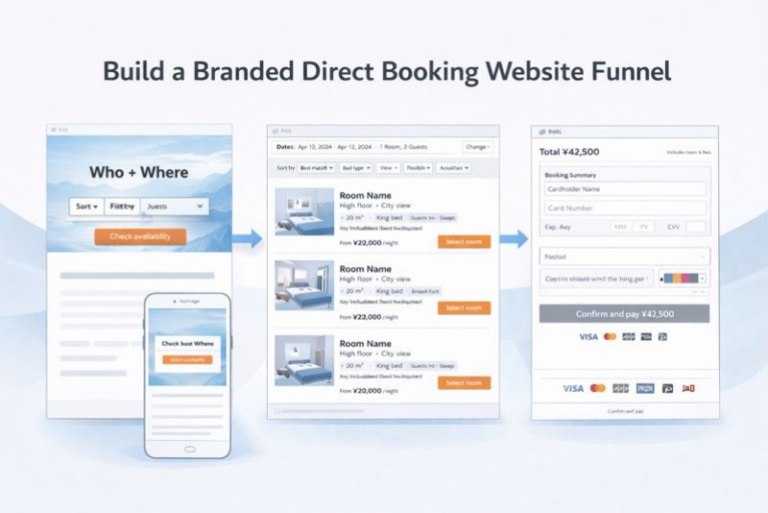
A user-friendly booking process is essential for increasing direct bookings. Embedding a booking widget on your hotel website lets guests make direct reservations easily, providing a seamless, efficient experience.
Optimize your hotel websites and booking platforms for mobile users, as most travelers use their phones to research and book accommodations.
Guests should be able to quickly understand the differences between rooms and complete checkout without friction.
It’s a conversion requirement.
Common Mistakes That Undermine Direct Bookings
- Treating all channels the same despite different costs
- Failing to synchronize bookings across multiple platforms and booking sites in real-time
- Not leveraging a channel manager to manage multi-channel rate plans.
- Claiming “value” that doesn’t change booking decisions
- Giving OTAs the full inventory even on high-demand dates
- Creating too many rate plans without a clear logic
- Expecting software to fix unclear distribution decisions
What Channel Managers Really Enable
Channel managers do not automatically reduce OTA fees.
They give you the ability to:
- Price based on real distribution costs
- Control availability deliberately
- Apply different rules across channels.
- Execute consistently without manual work.
Direct bookings increase when the offer makes sense, and the booking path works. OTA dependence falls when repeated commission becomes less necessary.
That’s the whole game: control the setup, enforce it consistently, and use guest data so the gains compound.