Hotel CRM vs Email Marketing: What’s the Difference?
You already send emails.
Your property management system sends pre-arrival notes. Your booking engine sends confirmations. Your team can send a newsletter when you have time. If you use an email platform, you can run promotions to a list.
But the same question keeps coming up: Do we need a hotel CRM?
Because the issue with guest communication isn’t the ability to send. It’s everything around sending: who to send it to, and whether the timing reflects what’s happening in the booking.
This article contrasts a Hotel CRM vs Email Marketing and shows you why you should consider a hotel CRM today.
What a hotel CRM is
A hotel CRM links a guest’s booking history to your guest communication. It allows you to automate guest messaging based on their reservation and past booking history, saving you time and increasing your repeat customers.
One sentence version:
- A hotel CRM helps you decide who should get what message, when, based on guest and stay behavior.
Quick bullets (what it typically does in a hotel context):
- Builds a consistent guest profile from hotel systems (not just an email address on a list)
- Keeps segments up to date as bookings change (new booking, cancellation, rebooking, date change)
- Supports lifecycle messaging tied to the guest journey (before, during, after the stay)
- Prevents waste by stopping messages that shouldn’t go out
- Helps you evaluate impact in hotel terms (bookings and returning guests, not just clicks)
A useful way to think about it: a hotel CRM is less about “email.” It’s about making guest data usable enough that your marketing can run on rules instead of memory.
The concept that matters is consistency: systems like The Hotel Growth Engine are built around the guest and the stay, not around the campaign calendar.
What email marketing is

Email marketing is a system for creating and sending email campaigns and automations.
One sentence version:
- Email marketing helps you build and send Email messages to a list, then track engagement.
Quick bullets (what it does well):
- Templates and design workflows.
- Scheduling sends and managing campaigns.
- Basic segmentation based on fields or tags you provide.
- Deliverability practices and list hygiene tools.
- Reporting on email performance (delivered, opened, clicked).
Email marketing tools can absolutely support automation. Many are strong at it.
But they don’t naturally know what’s happening in the guest’s stay—cancellations, date changes, rebookings, duplicate profiles—email tools typically won’t correct themselves without ongoing effort.
The difference
Email marketing sends messages. A hotel CRM makes guest data reliable enough that the right messages go out at the right time, to the right people, without constant manual cleanup.
That “without constant cleanup” is the practical difference. It’s also where the value shows up.
What a hotel CRM does that email marketing can’t
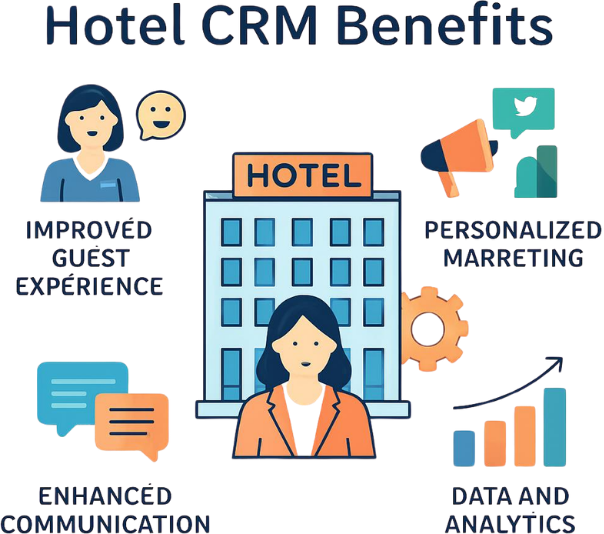
Below are the key differences in hotel operations. Each one reduces wasted effort, improves relevance, or protects margin.
1) It creates a guest identity you can trust
Hotels don’t have one neat list of “subscribers.” They have guests who book through different channels, change their email addresses, travel as couples or families, and appear in systems multiple times.
A hotel CRM is built to treat this as normal – it tries to make “this person” the same person everywhere.
Quick examples of why that matters:
- A repeat guest books once through an OTA and once direct. Without identity matching, they look like two different people.
- A guest’s email changes between stays. Your email tool may treat them as a new contact.
- A household shares an inbox. Your marketing sees one address, but there are two different stay patterns.
When identity is messy, targeting breaks. You send the wrong message to the wrong person, or you miss the right person entirely.
Email marketing platforms can store contacts. They can store fields. They can import data. What they usually don’t do well on their own is ongoing identity resolution in a hotel context—the “keep this person consistent even when the data isn’t.”
That’s why hotel teams often end up with:
- duplicate contacts
- conflicting tags
- segments that quietly drift out of date
A hotel CRM is designed to reduce that drift.
2) It segments by stay behavior, not list membership
Email marketing segmentation is only as good as the data inside the email system. In many hotels, that means segments are built from:
- manual exports
- static tags
- one-off lists created for a campaign
Those can work. They just don’t scale well, and they tend to go stale.
A hotel CRM is built to segment based on the things that actually drive hotel decisions, such as:
- How recently someone stayed
- Whether they are first-time or repeat
- Whether they usually book direct or through intermediaries
3) It runs timing off hotel events, not a marketing calendar
Most hotel email programs rely on a calendar:
- Monthly newsletter.
- Seasonal promotions.
- “need nights” pushes.
- Holiday campaigns.
A CRM doesn’t replace that. But it adds the part that calendars can’t do well: lifecycle timing that reacts to what the guest is doing.
A hotel CRM is designed to trigger and adjust messaging based on events like:
- Booking created
- Stay date approaching
- Guest currently in-house
- Guest checkout completed
- Time since last stay
- Booking cancelled
- Guest rebooked
This is where PMS-driven emails often fall short. PMS messaging can send operational sequences. It can be useful. But it’s usually not built to run marketing logic that accounts for the full guest picture.
The difference shows up in simple moments:
- A guest cancels. Do they still receive pre-arrival “we look forward to welcoming you” emails?
- A guest rebooks. Do they still get “we miss you” offers?
- A guest is in-house. Do they still receive a generic promotion meant for people deciding where to stay?
Lifecycle timing isn’t about sending more emails. It’s about sending fewer wrong ones and turning the right moments into repeatable systems.
4) It stops expensive mistakes with suppression rules
A big part of hotel marketing is knowing when not to send.
Email tools can suppress unsubscribes. They can exclude segments. But hotels usually need suppression that is tied to stay status and guest value.
A hotel CRM makes it easier to build rules such as:
- Don’t send a discount to someone who already booked again.
- Don’t send win-back offers to someone who stayed last week.
- Don’t send promotions to guests who consistently return without incentives.
- Don’t send messages that contradict what the guest is experiencing right now.
Suppression protects more than reputation. It protects your pricing.
If your best guests receive a steady stream of discounts, you train them to wait. If guests receive irrelevant messages, they unsubscribe, and you lose a direct line that costs you almost nothing to use once it’s working.
This is why a CRM is often worth it even before you “do more marketing.”
5) It lets you evaluate impact in hotel terms
Email reporting is useful. It tells you if a subject line worked, whether clicks went up, and whether your list is healthy.
But hotel decisions are usually not made on open rate.
Hotels need to know:
- Did this drive bookings?
- Did this bring guests back sooner?
- Did this increase direct share over time?
- Did it reduce how often we had to discount to fill gaps?
A hotel CRM is typically built to connect messaging back to guest and stay outcomes more directly than an email tool that only sees campaign engagement.
You’re not trying to become an analytics shop. You’re trying to answer one operational question:
Are we building a repeatable system that increases returning guests and direct bookings, or are we just sending emails?
The practical test

If you only remember one section, make it this one.
If the hotel data changes, does your marketing change automatically?
Use these checks:
- A booking is cancelled. Does that guest stop receiving pre-arrival messages?
- A guest rebooks. Do they stop receiving “come back” offers?
- A guest becomes a repeat guest. Do they move into a different message track?
- A stay date changes. Does your timing adjust, or do messages go out on the old schedule?
- A guest opts out in one place. Does that preference carry through consistently?
If your answer is, “We export lists,” “We update tags,” or “We do it when we have time,” you’re doing email marketing with hotel data.
That can work for simple programs. It just won’t stay accurate without ongoing manual effort.
A CRM-led approach is one in which segments and rules update as guest and stay data change.
When email-only is enough (and when it isn’t)
There are plenty of hotels that can run an effective program with email tools and a small set of automations. The key is to be honest about the goal.
Email-only is enough when
- You mainly send occasional newsletters, announcements, and seasonal updates.
- Your audience is small, and list cleanup is manageable.
- You don’t need complex “do not send” rules beyond unsubscribes.
- You’re not trying to run a structured repeat-stay program.
- You can tolerate some manual work to keep segments current.
In this setup, the risk is not failure. The risk is that the program stays stuck at the campaign level, because any step toward lifecycle behavior creates more manual work than your team can maintain.
A hotel CRM becomes worth it when
- Repeat guests are a major part of your revenue, and you want more of them.
- You want direct bookings to grow without relying on constant discounts.
- You need segments to stay accurate as bookings change.
- You have multiple systems, and the guest picture is fragmented.
- Your team is doing too much list work and too little improvement work.
- You want to stop sending offers to the wrong people.
In other words, a CRM becomes valuable when the hotel wants marketing to behave like an operating system, not a series of sends.
If you want a practical framework for turning guest data into repeat bookings and direct growth, explore The Hotel Growth Engine. It’s built around repeatable loops—segments, timing, suppression, and measurement—so your marketing improves without needing more campaigns every month.
Bottom line
Email marketing is the delivery method. It’s how messages leave the building.
A hotel CRM is what makes messaging reliable: consistent guest identity, segments based on real stay behavior, timing tied to hotel events, and rules that prevent waste. That’s what turns “we send emails” into “we run a repeatable system that brings guests back.”
FAQ
Is a PMS that sends emails the same thing as a hotel CRM?
PMS emails are often operational and stay-specific. A hotel CRM is built to manage guest identity, segmentation, and lifecycle marketing across stays, including repeat behavior and suppression rules that respond to changes in bookings.
Can an email marketing platform do automation without a CRM?
Yes, especially for simple sequences. The limitation is whether the automation stays accurate as hotel data changes. If it depends on manual exports or tags that go stale, the system won’t scale cleanly.
What’s the biggest practical benefit of a hotel CRM?
Less waste and more repeatability. A hotel CRM helps you send fewer wrong messages, reduce unnecessary discounts, and run lifecycle programs that keep improving because they’re tied to guest and stay behavior.
Do all hotels need a hotel CRM?
No. If your program is mostly occasional newsletters and basic updates, email-only can be enough. A CRM becomes worth it when you’re serious about repeat stays, direct growth, and reducing manual list work.
What should I look for when evaluating a hotel CRM?
Focus on behavior, not features. Ask whether it can maintain guest identity consistency, keep segments up to date as bookings change, enforce “do not send” rules, and show results in bookings and returning guests—not just in email engagement.