
The Destination Hotel Owner’s Guide to Building a Resilient Business
A destination hotel owner’s guide for those who own a lodge in a ski town, a hotel near the beach, a property in a mountain village, or a guesthouse on the coast.
The rooms are full. The reviews are good. And the money is coming in.
If you own an independent hotel in a destination market — whether you are in a ski town, a surf town, a mountain village, or on the coast — and the season is good, everything feels like it is working.
It might be. But there is something underneath that success worth looking at.
I have been exactly where you are. And I had to learn the hard way that what looks like a thriving business can be far more fragile than it appears.
This is the guide I wish someone had given me before the floor dropped out from under us.
We were in year three of running our own property. We had a 9.8 rating on Booking.com. The renovations were paying off, and the Bookings were rolling in. By every conventional measure, we were winning.
I thought we had built something real.
Then Covid hit. Bad timing. Insufficient resources. The region stopped drawing travelers.
I thought we were doing the right things at the time. We weren’t reckless. We weren’t naive. We followed the playbook. And the playbook didn’t build enough resilience for what came next.
What I didn’t understand about destination markets — and what it cost me

A hotel in a destination market is not like a city hotel. The distinction may seem obvious, but most advice treats all hotels the same.
They are not.
A city-centre hotel draws from a constant flow of demand — business travelers, conference attendees, weekend visitors, transit guests. When one source softens, others compensate. The market is relatively stable.
A destination property works differently. Your entire season can hinge on one or two variables:
- Snow depth or swell height
- Trail conditions or water temperature
- Flight routes and airline pricing
- Exchange rates and visa policies
- A diplomatic dispute that reroutes travelers
- A health event that closes borders
These are not edge cases. They are the operating environment of destination travel.
When the destination struggles, every property in it struggles.
Regardless of your reviews. Regardless of your occupancy the previous season.
I built for the boom. I didn’t realise the bust would expose everything I hadn’t built.
Why destination properties feel this pressure differently
When regional conditions are strong, success feels personal. Your occupancy is high, your reviews are climbing, and your rates are holding.
It‘s natural to attribute all of that to the quality of your operation.
Some of it is. But some of it is the destination performing well. That part of your success doesn’t belong to you.
The boom cycle is where fragility gets built — not through bad decisions, but through the absence of the right ones:
- Strong occupancy masks OTA dependency.
- Strong revenue masks a cost structure that only works in good times.
- Strong reviews mask the absence of a direct guest relationship.
Nothing in the numbers signals the problem while the season is running.
You don’t find out what you didn’t build until it stops.
What OTAs couldn’t do for me when I needed it most
Let me be direct about OTAs, because this is where a lot of advice gets it wrong.
OTAs are not the enemy. Booking.com, Expedia, Agoda, and Airbnb are powerful, done-for-you marketing. They put your property in front of travelers who are actively looking to book.
When you are starting out, when your area is still building its international profile, when you don’t yet have the brand recognition to drive traffic on your own, OTAs work.
Use them!
But they come with a structural cost that goes beyond the commissions you pay.
When you depend on a third party for the majority of your revenue, you are subject to their business decisions, their platform policies, and their priorities — not yours. That is fine when your interests are aligned. It becomes dangerous when they diverge.
The platform’s operational decisions become your business’s problem.
For a destination property, this exposure is acute in a way that it simply isn’t for a city hotel. A city hotel with consistent demand can absorb a platform disruption because other demand sources compensate.
A destination hotel in a slow season, in a market where regional traffic has dropped, with 80% of its bookings coming through a single OTA, has nothing to fall back on.
When the bookings stopped for us, I didn’t have a guest list to call. I didn’t have a direct channel to activate. I didn’t have a database of people who had stayed with us and might come back if we reached out.
I had an OTA profile and an empty calendar.
The OTA is a powerful starting point. But it is not a solid foundation
The math makes this concrete. A 23-room property generating $2 million in annual room revenue, running at 80% OTA dependency with a 20% effective commission rate, is paying roughly $320,000 per year in commissions. Every year. No equity building. No guest relationships owned. No compounding return on that spend.
You are renting your revenue channel—and the rent keeps going up every year you don’t build an alternative.
The destination property’s vulnerability
The OTA is not designed to solve your regional problem. It is designed to move inventory across its global portfolio.
When your destination softens — when the snow is bad, when the swell goes flat, when a flight route gets cancelled — the platform optimises for the platform. It surfaces alternatives. It adjusts algorithms. It promotes other destinations. Your listing doesn’t move up because you need it to.
This is not a criticism of OTAs. It is simply what they are. A marketplace. And in a marketplace, you are a supplier competing with every other supplier.
The platform’s incentive is to keep travelers booking — somewhere. Yours is to keep them booking with you.
Those interests are not always the same. In a strong season, the gap is invisible.
In a weak one, it becomes everything.
The guests who came back — and what they taught me about resilience

Through the experience of running our own properties and watching the businesses around me — the ones that survived and the ones that didn’t — I saw a pattern emerge.
The resilient businesses were not always the ones with the best location. They were not always the ones with the highest ratings or the most polished marketing. What they had was a guest base that came back for them — not just for the destination.
Think about the difference.
A guest who visits your area because it is a great ski town will come back when the snow is good and book wherever is available. A guest who visits because of your specific property — your people, your atmosphere, the way you made them feel last time — will come back to you regardless of what the broader market is doing.
You are no longer interchangeable with the hotel down the road.
I saw this with hotels in our area. The ones who focused on guest relationships survived the hard times. The ones that didn’t lost out.
That is the most durable competitive position an independent hotel owner can occupy. It has almost nothing to do with your OTA ranking.
When guests return for the destination, you compete with every property in it. When they come back for you, the competition disappears.
What a returning direct guest is actually worth
A Guests Lifetime Value shows the importance of repeat business.
A guest who books directly costs you nothing to acquire. A guest who comes back and books direct again costs you nothing — again. Compare that to the OTA guest: 20% commission, every booking, forever.
Direct bookers also spend more per stay. They are not in comparison-shopping mode. They have already made their choice. That changes how they interact with your property — how they respond to upgrade offers, how they engage with your team, how they talk about you when they get home.
A small number of returning direct guests, compounding over multiple seasons, creates a revenue floor that no OTA algorithm can take away.
That floor is what keeps the lights on when the market softens. It is what I did not have when I needed it.
Good intentions are not enough — you need a system

Independent hotel owners understand that guest relationships matter.
You know you should be following up after checkout, remembering returning guests, and building a direct booking channel. The intention is there. The execution isn’t — operations get in the way every single time.
Think about what your team is actually dealing with on any given day:
- A booking inquiry on WhatsApp
- A complaint through the OTA messaging system
- A question by email
- A check-in request through the website chat
- A guest calling about airport transfers
Every message arrives in a different place. Every message requires someone to stop, find context, reconstruct who this person is, and respond — before moving on to the next one.
There is no shared history. No continuity across channels or shifts.
In that environment, relationship-building is not impossible. It’s just the first thing that gets cut when the day gets busy.
Which means it gets cut almost every day.
The solution is to Stop Overthinking Guest Messaging and start using a Hotel CRM so that you can focus on your guests.
What the CRM actually does
A hotel CRM makes relationships scalable.
What changes when you have one in place:
- Unified messaging consolidates guest communication into a single view — regardless of which channel it came in on.
- Guest history means the person answering the phone this afternoon knows what happened when that guest stayed last February.
- Communication continuity means that when staff change shift, the context doesn’t disappear with them.
The difference is not the technology. It is what the technology makes possible — more repeat guests, more direct bookings, less commission paid, every year.
How to build it — the three stages every destination hotel owner needs to work through
If you are reading this and recognising the fragility in your own business model, the question is not whether to change course. It is where to start.
Stage one: Use the OTAs — but start owning the relationship from day one.
OTAs get you started. They bring in bookings when you don’t yet have the brand recognition to do it yourself. Use them. But from your very first booking, treat every guest who comes through as someone whose relationship you are actively working to own.
- Get their details into your own system.
- Follow up after their stay.
- Give them a reason to come back to you directly next time.
The OTA introduced you. The relationship is yours to build.
Stage two: Build your own visibility.
You cannot build a direct booking channel if nobody can find you outside an OTA. That means creating your own presence in the places your future guests are looking — search engines, social platforms, travel communities.
This does not require a massive budget. It requires consistency and the right content. Answer the questions your guests are already asking:
- Conditions and forecasts (snow reports, surf conditions, trail status)
- Local transport options and airport transfers
- What to pack for your specific destination
- Where to eat, what to do, when to visit
Be the most useful resource available for a traveler planning a trip to your area, and you will be visible when they are ready to book.
Content compounds in a way that paid advertising alone does not — though paid ads, run well, can accelerate the process considerably in the early stages.
The goal is to get your future guests onto your own platform — your website, your email list — before they ever arrive on an OTA. The Hotel Content System is built specifically for this.
Stage three: Build the relationship engine.
Once you have visibility and you are capturing guest contact information, you need the infrastructure to convert that into a compounding direct booking channel:
- A hotel CRM that consolidates your communication.
- A direct booking path that converts visitors into reservations.
- An automated follow-up sequence that keeps the relationship alive between stays.
- A repeat booking system that makes returning guests feel like coming home.
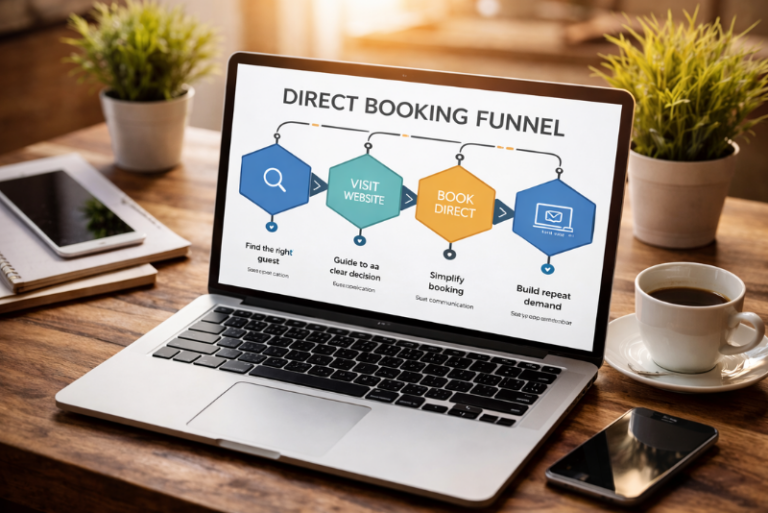
This is where the compounding starts. And it is where How to Build a Direct Booking Funnel picks up in detail.
Visibility without a relationship system is just traffic you are renting. The system is what turns it into revenue you own.
The compounding effect — why the investment front-loads the pain and back-loads the returns
The honest reality of building a direct channel is that the early years are hard.
Year one of investing in content, SEO, and a CRM looks like a cost with very little reward. Year two looks marginally better. Year three is where the curve starts to bend.
However:
- SEO authority builds over time. Every piece of content you publish that answers a guest’s question is an asset that keeps working after you have stopped paying for it.
- Repeat guests compound. Every returning guest who books direct is one fewer commission you will ever pay for that relationship again.
- Guest history deepens. Every year you run your CRM, your communication becomes more personal, and your team becomes more effective.
Most independent hotel owners don’t make this investment because the early period is hard and the timeline is long.
That is exactly why the ones that do have a durable advantage. By the time their competitors recognise the need, the gap is already significant.
The resilient destination hotel is built before the storm, not during it
The lesson I carry from my own experience is not that disruption is inevitable, or that bad luck is something you absorb. It is something more specific.
The hotels still standing after every major disruption — bad snow years, border closures, platform algorithm changes, regional downturns — are not standing because they were luckier or better located. They are standing because they built something that the external conditions couldn’t take away.
A guest base that chose them specifically. A direct booking channel that they owned and operated. A relationship infrastructure that kept working when the OTA traffic dried up, and the area went quiet.
That infrastructure is not built during a crisis. It is not built when the market softens, and you suddenly realise you have no guest list to contact.
It is built during the good seasons — when the revenue is strong enough to invest, when the capacity exists to focus, when the urgency hasn’t arrived yet to crowd out everything else.
About Hotel Growth Engine
Hotel Growth Engine helps independent hotel owners in destination markets build the systems behind resilient direct booking businesses. Unified guest messaging, CRM, and reputation management in a single platform — so your team has the context they need, your guests feel genuinely known, and your strongest relationships become the engine behind repeat bookings, direct revenue, and long-term growth.
If You Want A Business That Doesn’t Depend On The Season