The Content Gap Between You and More Bookings
For destination hotels looking to drive more direct bookings and get away from OTA dependence by identifying and filling their content gap.
You’ve thought about content. Maybe you’ve even started. A post about local restaurants. A seasonal guide. A quick write-up about what to do in town.
Then it stalled. It was too time-consuming, you weren’t sure what to write, and you didn’t see any impact.
The internet is full of “50 hotel blog ideas” lists. Staff spotlights. Behind-the-scenes tours. Event roundups. They’re written for every hotel everywhere, which means they work for nobody in particular.
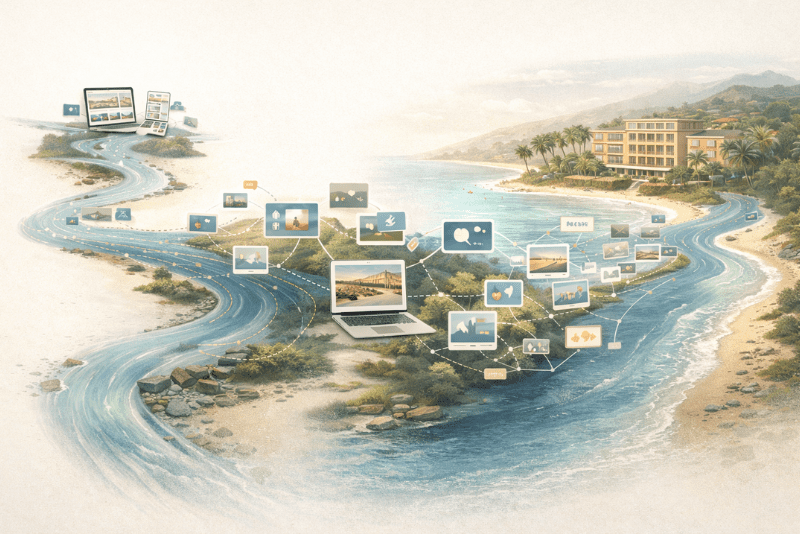
Your property is different. You’re in a destination market. Your guests aren’t walking in off the street — they’re planning a trip weeks or months in advance.
They research and compare before deciding to book.
And they’re asking questions at every stage of that process.
The content that drives direct bookings for your hotel isn’t a random list of topics. It’s the specific answers your ideal guests need, delivered at the exact moment they’re searching.
Your Blog Is Direct Booking Infrastructure
Most hotel owners treat their blog as a marketing nice-to-have. Something to get around to eventually.
It’s not. It’s the system that controls your online visibility. It answers the questions your guests are already asking — before they know you exist, while they’re deciding which hotel to book, and after they’ve committed to the trip.
Every post compounds over time. Traffic accelerates. Bookings follow.
But only if you’re connecting with the right people at the right time.
Your Guest’s Journey Has Three Stages
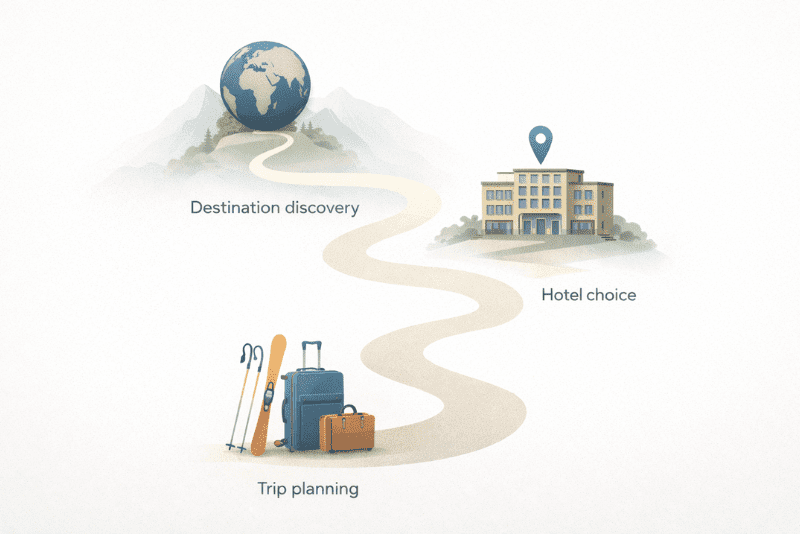
Most hotel owners focus only on the last stage of the guest journey. That’s a mistake.
Here are the three stages every destination hotel should consider when creating content.
1 – Top of Funnel — Location Discovery
Your guest hasn’t decided where to go yet. They’re asking:
- “Where should I ski this year?”
- “Which country has amazing hiking?”
- “What makes Whistler different from Banff?”
They don’t know your hotel exists. They might not even know your destination exists.
Your job here is to position the destination, not the property.
2 – Middle of Funnel — Hotel Choice
They’ve picked a location. Now they’re comparing hotels:
- “Which hotel has the best ski access?”
- “Does this property include breakfast?”
- “How close is the bus stop to the lifts?”
This is where your value proposition matters. Why should they choose you over the hotel down the street?
3 – Bottom of Funnel — Trip Planning
They’ve booked. Now they need answers:
- “What should I pack for a ski trip to Japan?”
- “Where do I rent gear?”
- “What restaurants are walkable from the village?”
- “What do non-skiers do all day?”
This is often the easiest stage to write for. Your guests are literally telling you what to write about every day.
Why Content Is Often Hard to See
You live in your destination.
You play there. You know which restaurants are good. You know why people come. You’ve already made the decisions your guests are still trying to make.
You can’t see their questions.
A family from Singapore doesn’t know that the rainy season is from May to June. They don’t know if it’s safe. They don’t know how to get there from the airport. They don’t know if there are any kids’ activities.
To you, these questions seem obvious. To them, these questions determine whether they visit your region or fly to Whistler instead.
You live in your destination. The hardest part of content is seeing the questions your guests ask — because you stopped asking them years ago.
Your own familiarity with the place becomes a barrier.
Start With Your Ideal Guest — Not a Keyword Tool
Before you open any SEO tool, you need to answer two questions:
- Who actually books your hotel?
- What do they need to know at each stage of their journey?
These answers vary from property to property. A luxury lodge in Hakuba has a completely different content map than a budget hostel in Australia. The funnel stages are the same. The content inside them is not.
If you haven’t defined your ideal customer profile (ICP), start by looking at who’s already booking you. What countries are they from? What time of year do they visit? What do they ask about before they arrive?
Building a detailed ICP is its own process — we’ll cover that in a future article. For now, the key is this: every content decision flows from knowing your guest.
Skip that step, and you’ll write content that ranks for nobody and converts no one.
Where to Actually Find Content Ideas

Stop guessing. Start looking. Here are recommended sources for each funnel stage.
Top of Funnel: What Outsiders Ask Before They’ve Decided
- Google search: Start by asking the questions you would ask if you were traveling to a new destination.
- Travel forums: Reddit, Facebook groups, destination-specific communities. Read threads where people are deciding between destinations. The questions they ask are your content ideas.
- Your own empathy: Imagine you’re planning this exact trip for the first time. You’ve never been to your destination. What would worry you? What would you search for?
- Competitor positioning: Go to a travel convention. Read how competing destinations market themselves. What questions are they answering? What are they missing?
- Tourism guides: What does your region’s tourism board emphasize? What’s the official story? Where are the gaps in what they cover?
Pay attention to the basic questions. The ones that feel too obvious. Those are gold.
Middle of Funnel: Why People Choose You Over the Competition
- Ask your guests directly: Survey them at check-in or in a post-booking email. One question: “Why did you choose us?” The answers will surprise you.
- Your value proposition: What are the specific reasons people book you? Breakfast, location, price, family-friendliness, luxury, vibe? If you can’t name these clearly, spend some time developing your value proposition.
- Pre-booking inquiries: What do people email you asking about before they commit? These questions reveal what’s stopping them from booking.
- Competitor reviews: Read what guests say about other hotels in your area. What do they praise? What do they complain about? That tells you what matters to guests when choosing between properties.
Bottom of Funnel: Your Guests Are Already Telling You What to Write
This is the goldmine most hotel owners walk past every day.
- FAQ questions: Track what guests ask repeatedly. If ten guests a month ask, “Where do I rent ski gear?”, that’s an article.
- Support emails: What problems do booked guests bring to you before they arrive?
- Guest reviews: What do people mention they struggled with or loved? Both are content ideas.
- Pre-arrival emails: What do confirmed guests want to know between booking and check-in?
Bottom-of-funnel content solves two problems at once. It increases visibility but also reduces operational load.
Instead of your staff answering the same question fifty times a season, you link to the article in your booking confirmation email. Guests arrive with answers. Your team spends less time on repetitive questions.
Better yet, use a hotel CRM to automatically send a highly personalized booking confirmation email.
That’s content doing double duty.
Organize It Simply — Then Execute
The key is not to overthink or overcomplicate this.
Doing Your Research
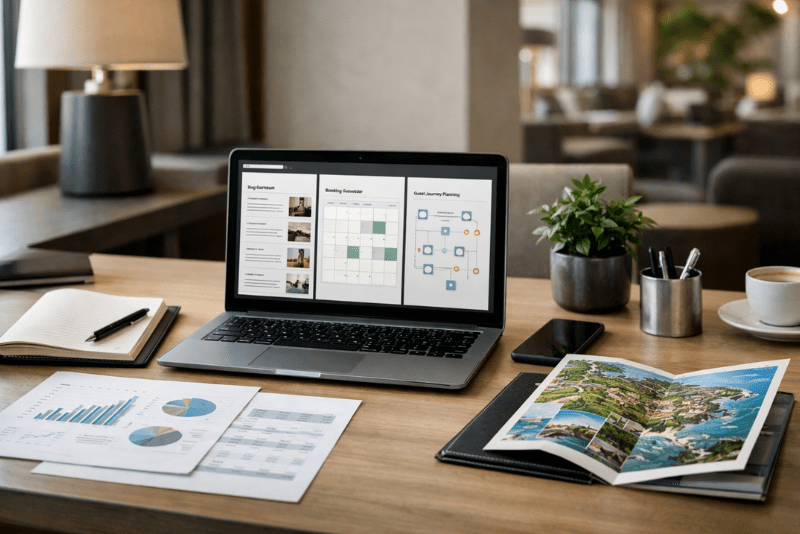
Use a Google Doc to document all the questions/topic ideas.
Create three sections:
- Top of funnel — Location discovery questions
- Middle of funnel — Hotel choice questions
- Bottom of funnel — Trip planning questions
Every time you find a question — from Google, forums, guest emails, check-in surveys, competitor research — drop it into the right section.
Prioritize by Common Sense, Not Search Volume
You don’t need a keyword tool to know which ideas matter most. Ask yourself:
- How often does this question get asked? (Frequency signals demand.)
- If I were this guest, what would I need to know first?
- Would this question stop someone from booking if they couldn’t answer it?
You can validate with a quick Google check or ask AI to help prioritize. But don’t let analysis paralyze you. The goal is content on your site, not a perfect spreadsheet.
Pick One Topic From Each Stage and Repeat
Start with the easiest articles to write. Not the hardest to rank for.
Choose one topic from the top of the funnel. One from the middle. One from the bottom. Write them. Publish them. Then do it again.
If you can publish one article a week, do that. If you can only manage two a month, do that.
Write at whatever pace you can consistently maintain.
If you can’t write the content yourself, hire someone. Use AI. Whatever gets it out the door. But if you’re using AI, make sure it reads as a human wrote it. Auto-published AI content that sounds like a robot won’t build trust — and your guests will notice.
Master One Channel First — Before You Expand
This process applies to content, not just blog posts. The questions your guests ask can become:
- Blog articles
- YouTube videos
- Social media posts
- Email sequences
But don’t try to do all of them at once.
Pick one channel. Master it. Build a library of content that covers all three funnel stages for your ideal guest profiles.
Once that channel is producing results, add another. Take your best-performing blog articles and turn them into YouTube shorts or vice versa.
The Long Game: Consistency Compounds
This isn’t a one-and-done strategy.
One article won’t move the needle. You need to know that going in.
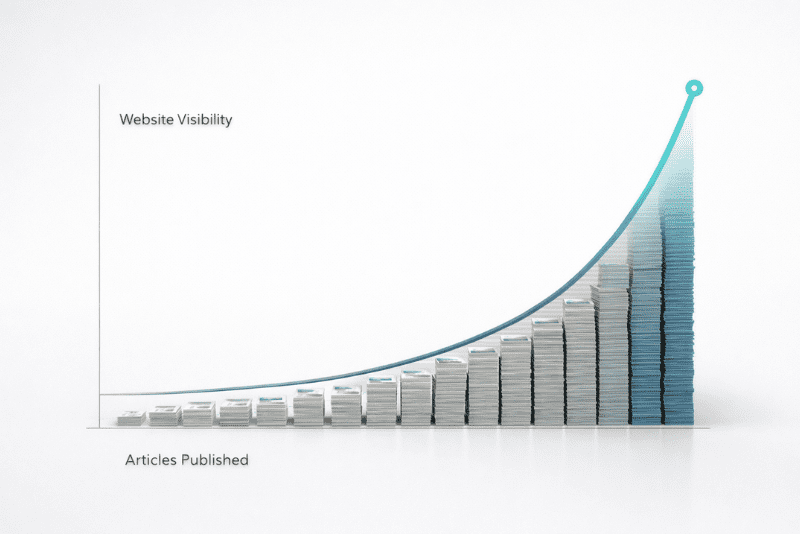
Here’s what the data shows: traffic doesn’t grow linearly. It compounds.
- The first 15-20 posts lay the foundation. You probably won’t see much short-term impact.
- By 50 posts, traffic starts to accelerate. Each new post builds on your earlier work.
- 75-100 posts, the returns become exponential. Your site ranks for dozens of long-tail searches. You’re appearing in destination discovery searches.
Every post you publish makes every other post more valuable. That’s the compounding effect. But it only works if you keep going.
Most hotel owners give up. Consistency is hard, especially when your business is doing well. Why spend the time and effort on marketing, especially when you don’t see quick returns?
But the hotels that push through? They build something their competitors can’t replicate quickly. A library of content that owns their visibility, answers their guests’ questions, and drives direct bookings — without paying OTA commissions on every reservation.
That’s called resilience, and it creates stability in the good and the bad times.
Start Today
You don’t need a content strategist. You don’t need expensive keyword tools. You don’t need a marketing degree.
You need to understand your guests. You need to know what questions they ask at each stage of their journey. And you need to answer them.
- Identify your ideal guest profiles.
- Map their journey from destination discovery through trip planning.
- Find their questions using the sources above.
- Document everything in a simple list, sorted by funnel stage.
- Pick one topic from each stage and write it.
- Repeat — consistently.
Your guests are searching for answers right now. If you’re not writing them, someone else is. And that someone else is getting the booking.
Your blog can drive direct bookings — but only if you know what to write. Let us do that for you.
About The Fifth Business
The Fifth Business is a hotel marketing company and the creator of Hotel Growth Engine, a CRM and automation platform that connects your inbox with your property management system. We help hotels increase direct bookings, improve guest communication, and build stronger long-term revenue.