
Why Most Hotel Review Requests Fail – And How To Fix It
Why your hotel review requests usually fail, and how to build a system that guests actually respond to.
Hotel reviews matter. You check your Google rating, you scan TripAdvisor. You notice bookings drop when a competitor edges above you in the rankings.
So you try the obvious fixes.
- Add a Google review link to the post-stay email.
- Print a QR code for the front desk.
- Turn on an automated review request.
- Ask staff to mention reviews at checkout.
And still, response rates stay low.
If you want more reviews, you need more than a message. You need a process that uses psychology, that reduces friction, arrives at the right moment, and feels connected to the stay the guest just had.
The majority of your guests leave satisfied but never write a review. The challenge is converting the quietly happy majority into credible public proof.
Hotels that consistently generate reviews have built a system grounded in human psychology, not in email automation.
Reviews are not just reputation
Hotels often treat reviews as a reputation-management task. Something to monitor, respond to, and improve over time.
That is too narrow.
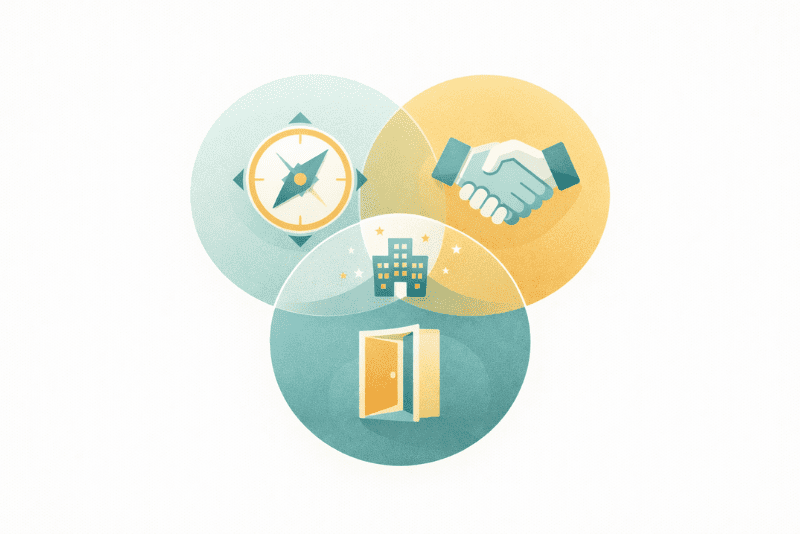
A strong review profile affects three parts of hotel marketing at once:
- Discovery: Reviews influence how visible the hotel is in local search and map-based search behavior.
- Conversion: Reviews reduce uncertainty for guests when deciding whether to book.
- Trust: Reviews serve as public proof for guests who do not yet know the property.
For chain hotels, some of that trust exists before the guest even sees the listing. The brand already carries weight.
Independent hotels do not get that advantage.
A first-time guest comparing unfamiliar properties in a destination market is usually making a decision with limited information. Photos often look similar. Amenities sound similar. Location descriptions blur together. Rate differences may be small.
The Review Request Paradox

One reason hotels get this wrong is that they assume asking more often will naturally produce more reviews.
It does not work that way.
A study published in Tourism Management found that direct review solicitation on TripAdvisor reduced the volume of organic reviews by 15.5 percent.
Actually asking for reviews decreased rather than increased the number of responses.
The goal of a review request process is to engage guests and emotionally invest them in writing a review.
That is the difference between a review request and a review system.
What the biggest review platforms get right
Before building a hotel-level system, it helps to look at the platforms that collect reviews at scale.
Booking.com, TripAdvisor, and Google all approach review collection differently — but underneath the surface, they’re running the same underlying principles:
- Timing: the ask arrives while the stay is still recent.
- Friction removal: the path to review is direct.
- Low barrier: the first action is small.
- Consistency: the system runs every time, not only when the staff remembers.
Those are the table stakes.
What platforms cannot do for an individual hotel is add the human layer. That is where hotels still have an edge.
A hotel can connect the ask to a real stay, a real person, and a real relationship. That is what turns a generic prompt into something the guest is more likely to act on.
The Principles That Increase Response Rate
The gap between a 5 percent and a 30 percent response rate is not due to a better email template. It’s an understanding of three principles of behavioral psychology that govern whether someone follows through on a request or ignores it.
1. Reciprocity
Guests are more likely to respond when the request feels connected to the hospitality they just received.
A faceless branded message feels like marketing. A message from a real person who was part of the stay feels more like a genuine follow-up.
That difference matters because the request no longer feels self-serving. It feels like part of the relationship.
2. Small actions make larger actions easier
Guests are much more likely to leave a public review if they have already said yes to or completed something first.
3. Verbal commitment matters more than most hotels realize
A guest who agrees in person is much more likely to follow through.
The 5-Step Review Process
Here is the 5-step system you can implement today to increase the number of reviews your hotel receives.
1. Deliver an experience worth talking about
No review system can compensate for a stay that felt merely adequate.
Guests do not write because the hotel asked. They write because they have something clear enough to say.
That does not always mean luxury or surprise. It means the stay gave them something concrete to remember.
If your hotel wants better reviews, it has to know what guests are most likely to mention positively and make those moments more consistent.
2. Prime the guest at checkout

This is the highest-leverage step in the system.
The goal is not to push a review ask at the front desk. The goal is to prepare the guest for the follow-up.
A good checkout mention does three things:
- Set expectations: “We’ll send a short feedback survey after checkout.”
- Expresses appreciation: “We’d really appreciate it if you filled it in.”
- Connect the ask to the purpose: “It helps us improve the stay for future guests.”
What it should not do:
- Mention Google immediately.
- Ask for five stars.
- Sound scripted.
- Feel like staff are chasing marketing output.
The ask works because it is soft, useful, and believable.
When the guest sees the message later, it is not random. It is recognized. That alone changes open and response behavior.
3. Send a short survey within 24 hours
The survey is where the system becomes operational.
It should be short enough to complete in under two minutes. Five questions are usually enough. The purpose is not only to collect feedback. It is to move the guest into a small act of participation while the stay still feels concrete.
A useful survey does three jobs at once:
- Captures feedback that the hotel can actually use
- Identifies satisfaction level
A few rules matter here.
- Keep the timing tight: Within 24 hours is usually the best window.
- Use the channel the guest already knows.
- Use a real sender: A named person with an operational role works better than a faceless hotel identity.
4. Route based on satisfaction

Not every guest should receive the same follow-up.
Guests who indicate a strong stay should be given a direct, immediate path to leave a public review.
That follow-up should be simple:
- one sentence
- one link
- one platform path
Do not make the guest choose between multiple review sites unless there is a clear reason to do so. Too many options create drop-off.
Guests who indicate a weaker stay should move into a different path. That path should usually be an internal follow-up from someone who can respond meaningfully.
That gives the hotel two advantages:
- It creates a chance to recover the relationship before frustration hardens.
- It shows the guest that feedback leads to action, not just data collection.
This routing logic is the same principle behind preventing negative hotel reviews — intercepting dissatisfaction before it becomes public.
5. Respond to reviews as public booking content
Most hotels still underuse this step.
A management response is not just a customer service reply. It is public-facing content read by future guests.
That means every response is doing at least two jobs:
- acknowledging the reviewer
- shaping how future guests interpret the property
Good review responses are usually:
- brief
- specific
- written in natural language
- tied to something the guest actually mentioned
That applies to positive and negative reviews.
Future guests are reading for clues. They want to know whether the hotel is attentive, accountable, and real.
Five Mistakes That Kill Your Response Rate
Most independent hotels make at least two of these mistakes. They’re not obvious, which is why they persist.
- Skipping the checkout conversation
- Sending the request too late
- Making it hard to leave a review
- Switching channels unexpectedly
- Sending from a faceless brand
Next Steps
You don’t need software to start. You need a conversation, a survey, and a link.
- Write a checkout conversation guide for your front desk staff. Not a word-for-word script — the key principles: set the expectation, express genuine appreciation, connect it to improvement. Let staff find their own voice.
- Set up a simple satisfaction survey. Google Forms works. Five questions. Keep it under two minutes. Focus on what matters most to your property.
- Create a direct link to your Google review page. Test it yourself. Make sure it goes straight to the review form — not your listing, not your photos, the actual form.
- Automate the survey send for 24 hours post-checkout. Use whatever system you already have — your PMS, your email tool, a scheduling app. The method doesn’t matter. The timing does.
- For guests who score high on the survey, add a follow-up message asking if they’d share on Google. One link. One sentence. Make it feel like a natural continuation of the conversation, not a separate ask.
That’s the minimum viable system. It will outperform whatever you’re doing now because it’s built on the psychology of why people actually follow through, not just the mechanics of sending a message.
Build the System That Runs Without You
Getting reviews is one part of the puzzle. Managing them — responding consistently, monitoring your reputation across platforms, and turning guest feedback into operational improvements — is the ongoing work.
The Hotel Growth Engine brings your guest communication, review management, and reputation monitoring into one system. Automated review collection, unified messaging, and reputation tracking — built for independent hotels that want the system without the complexity.