Direct Booking Funnel Automation for Independent Hotels
When people say “direct booking funnel automation,” it sounds like software talk.
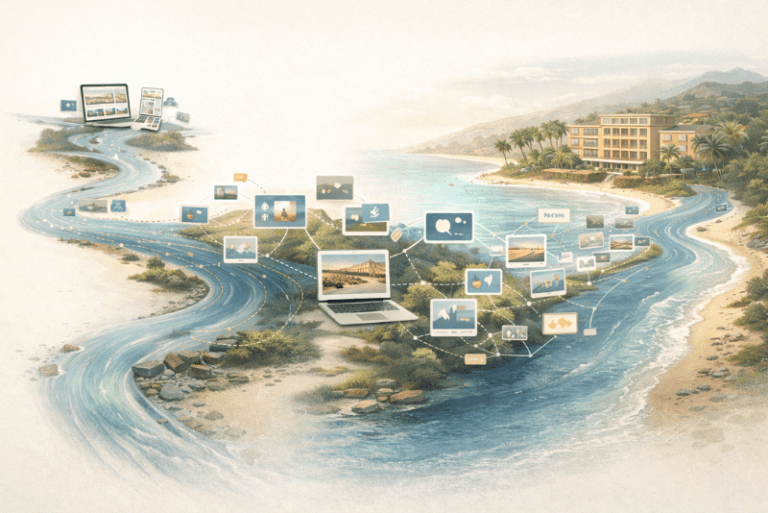
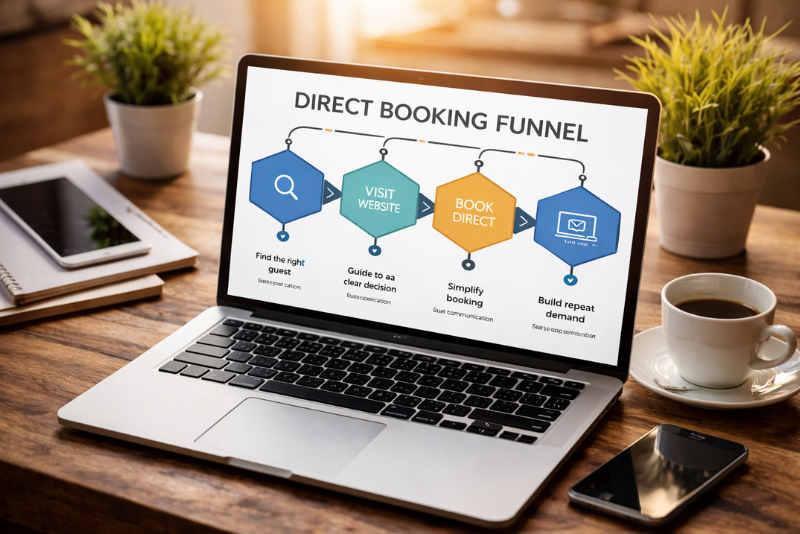
In simple terms, it’s the system that takes someone from discovering your hotel to booking, arriving, staying, and coming back—without your team manually pushing every step.
Direct booking funnel Automation for independent hotels isn’t strategy. It’s what keeps the work consistent when the hotel is busy.
A direct booking funnel has four jobs:
- Help the right guest discover you.
- Make it easy for them to book as soon as they land on your site.
- Keep guest information and communication organized so staff can respond fast and personally.
- Use pre-arrival and post-stay messaging to reduce friction, answer questions, and create more repeat business.
1) Discovery: How the Right Guests Find You
Discovery is visibility before the guest is ready to book. For most independent hotels, the practical inputs look like this:
- Google Maps presence (Google Business Profile + reviews)
- Written website content that matches search intent (Google traffic, and increasingly AI-driven discovery)
- Social distribution (reach driven by consistency and iteration, not “automation”)
- Paid ads (a controllable way to increase traffic when you want to)
The point is not doing everything. The point is building one or two discovery engines you can run consistently.
Google Maps presence: Google Business Profile + reviews
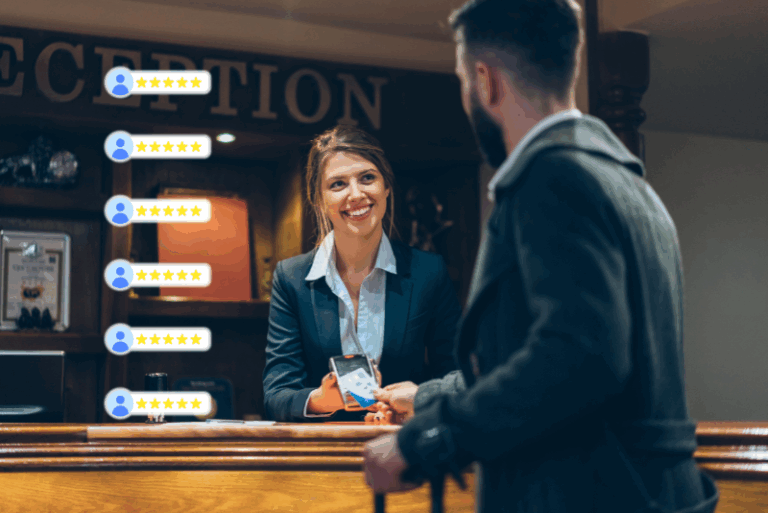
If you care about local discovery, this is foundational. Your Business Profile needs to be correct and complete, but reviews are what keep the listing competitive over time.
Most hotels don’t “choose” to be inconsistent here—they get busy, and the habit breaks. That’s why the automation belongs specifically in the post-stay flow:
- Every guest gets a review request.
- It goes out at a consistent time after checkout.
- It’s simple, with one clear link.
- Someone on the team owns routine monitoring and response.
That’s the system. It keeps the baseline strong without relying on staff memory.
2) Content: What It Means in Practice
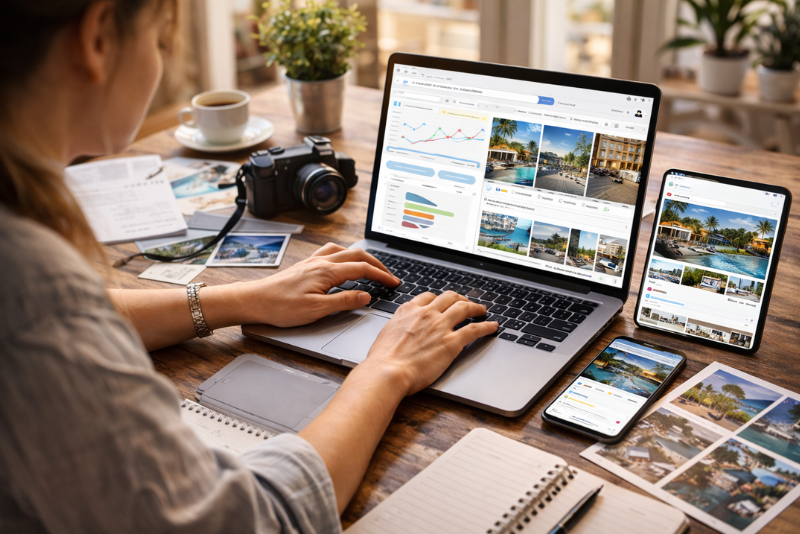
When I say “content,” I mean two different things. Operators often lump them together, but they behave differently and serve different purposes.
A) Written content on your website (intent capture)
This is the content that pulls in guests who are actively searching. It’s the type of content that surfaces in AI-driven search experiences because it clearly answers specific questions.
This content should be useful and specific. It should cover topics that directly affect booking decisions, such as:
- How to get to your property (from major transit points)
- What the destination is like by season
- What to do nearby for different guest types (families, couples, outdoor travelers, longer stays)
- What to pack / what you provide
- Room type differences and who each one is best for
- Policies and logistics that reduce hesitation (late arrival, parking, luggage, etc.)
This is not about publishing endlessly. It’s about building the right pages that match real intent.
B) Social content (reach and repetition)
Social can put your hotel in front of guests before they search.
The key is not automating creative output. The key is being consistent long enough to find what actually works. Most hotels don’t fail because their content is “bad.” They fail because they never do enough repetitions to learn what content works.
If you use social, treat it as a manageable operating rhythm: a cadence you can sustain, a simple workflow, and a routine for reviewing what performs and iterating.
3) When They Land on Your Site: Make The One Next Step Obvious
When someone reaches your website, you’re guiding the decision.
Most independent hotels lose bookings here because they give guests too many choices at once—too many buttons, too many paths, not enough hierarchy.
A funnel works when there is one primary decision point.
That might be:
- Check availability
- Book now
- Submit an inquiry (for higher-touch stays)
Pick one primary action and make everything support it.
Ads make this painfully clear. Ads can drive a lot of traffic, but traffic only matters if the landing experience leads to one decision. If the guest has to figure out what to do, conversion drops.
Automation can support this stage—follow-up for incomplete bookings, inquiry routing, confirmations—but it won’t rescue a scattered decision path.
Build the structure first.
4) Centralize Guest Communication and Booking Context
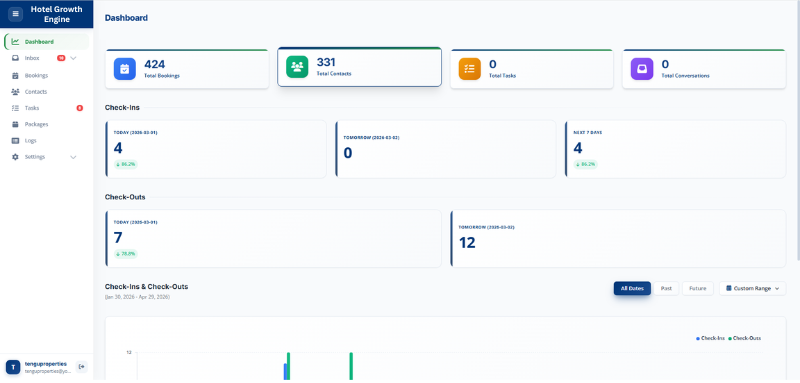
If you want this funnel to work reliably, communication has to be part of it.
Many hotels split guest information across:
- PMS notes
- email threads
- messaging apps
- booking platform messages
- spreadsheets
- staff memory
That fragmentation slows responses and leads to mistakes, especially during handoffs between team members.
The goal is simple: when staff respond, they should immediately see who the guest is, what they booked, key dates, and prior communication—without having to hunt.
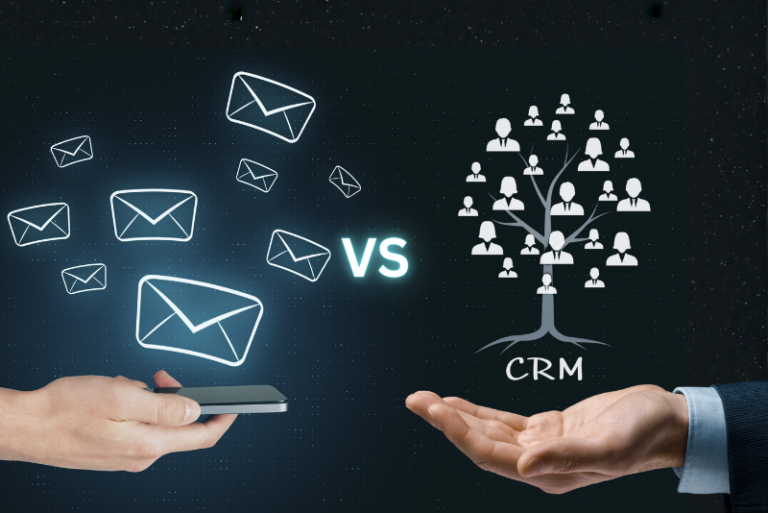
This is where a hotel CRM matters, but only in the practical sense: it centralizes booking + guest info + communication history so staff can respond quickly and consistently, and so your guest relationships don’t reset to zero every stay.
5) Pre-Arrival Automation: Reduce Repetition and Improve the Stay
Independent hotels get buried in repeat questions. Pre-arrival messaging is where automation pays off fast.
A structured pre-arrival sequence should:
- cover arrival instructions and access
- set expectations for check-in/check-out
- answer the predictable FAQs
- handle local logistics that always come up
- offer relevant add-ons that improve the stay (not generic upsells)
The goal is to reduce repetitive staff load and make arrivals smoother. When the basics are handled automatically, staff can spend time on the requests and moments that actually improve the guest experience.
6) Communicate Where the Guest Chooses to Communicate
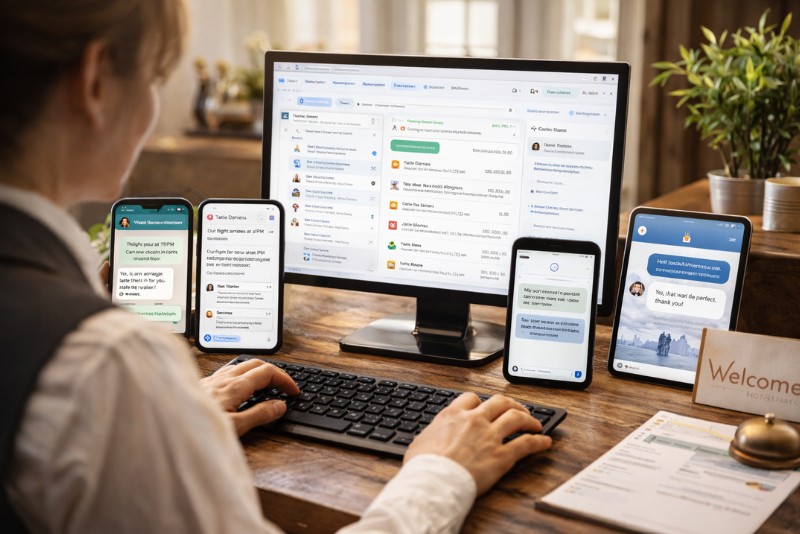
Guests use different channels: email, WhatsApp, SMS, and OTA messaging.
You don’t want to force channel changes. That creates friction and increases the risk that your team will lose context.
Your system needs to support responding on the guest’s preferred channel while keeping the conversation tied back to the same guest record.
That’s how you scale relationship-building without increasing staff effort.
What This Changes for Your Hotel
When your funnel is built properly and the repetitive parts are automated, the hotel runs differently.
Your discovery engine becomes more consistent. Your website converts better because there’s one clear next step. Staff respond faster because the guest and booking context aren’t scattered across tools and spreadsheets. Pre-arrival questions drop because guests receive the information they need before they ask.
The practical outcome is that your team gets time back and uses it where it matters: delivering a better stay and handling real exceptions, not repeating the same explanations.